Putting tools in the hands of those who already have the skill.
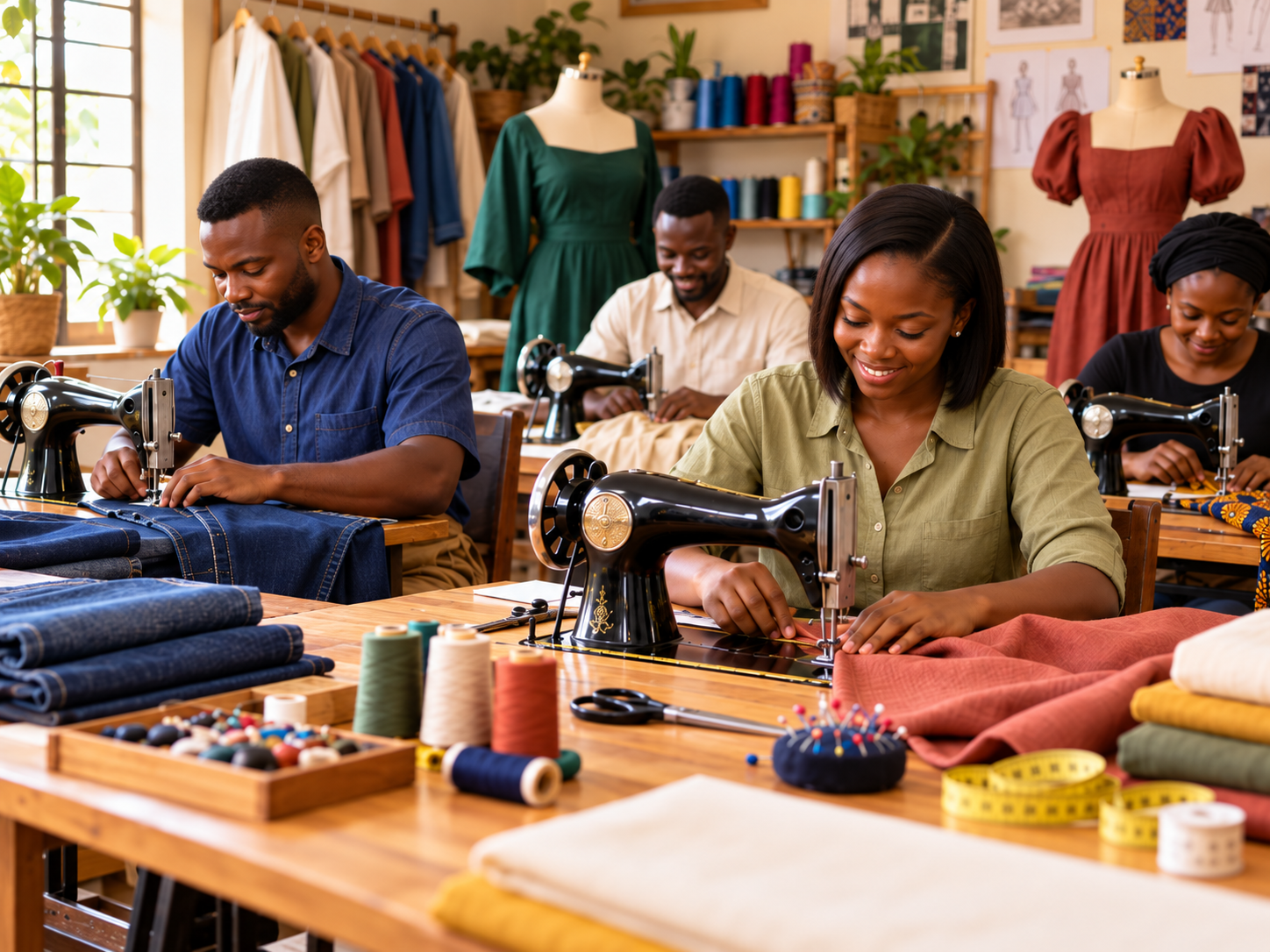
Helping skilled tailors and aspiring fashion entrepreneurs turn existing sewing ability into greater opportunity — by providing one of the most important tools of the trade: a manual sewing machine.
Sometimes the skill is already there. What's missing is the equipment.
Asake's Projects provides manual sewing machines to selected recipients in Nigeria who have sewing or tailoring ability but face a financial or practical barrier to owning a machine of their own.
Application Deadline: October 30, 2026
Sewing Machine Giveaway: January 2027
Asake's Projects is a registered 501(c)(3) U.S. nonprofit. All donations are tax-deductible to the fullest extent allowed by law.
— THE GAP
The skill may already be there. The machine isn't.
Learning a trade is only part of the equation. A skilled tailor may know how to measure, cut, construct, alter, and finish garments, yet still depend on a borrowed machine, rented equipment, an employer's workspace, inconsistent access, or no machine at all.
That equipment gap shapes real, everyday outcomes. It limits how often someone can work, how many customer orders they can accept, how much they can practice, and how independently they can operate as a tailor or emerging fashion entrepreneur.
Asake's Projects focuses on that specific barrier. The goal is not to teach what recipients already know, but to help put the machine into capable hands.
— OUR APPROACH
One practical tool. Many possible next steps.
The Sewing Machine Initiative is intentionally simple. We identify skilled applicants whose ability outpaces their equipment, provide sewing machines, and follow their progress where practical.
01 — Identity
Tailoring Skills
Identify applicants with existing sewing or tailoring skills for whom machine ownership could meaningfully improve their ability to work.
02 — Provide
Provide
Selected recipients receive a sewing machine of their own: a piece of productive equipment they can use, own, and rely on.
03 — Follow
Follow
Where practical, Asake's Projects follows recipient stories and progress to understand how machines are being used and shared.
— OUR COMMITMENT
We come back.
The giveaway is not the end of the project. We follow up with every recipient at three defined checkpoints after a machine is delivered. We ask what has changed, what hasn't gone to plan, and what we could do better.
03 MONTHS
Early check-in
We confirm the machine is working and hear what the first weeks of use have been like.
06 MONTHS
Mid-point review
We ask how the machine has shaped the recipient's work and what has shifted since the start.
12 MONTHS
Year-end documentation
We take stock of a full year's work and share what we have learned, with the recipient's permission.
Requirements (additional requirements will be in the application form):
Applicants must be located in Lagos State or Ondo City.
A minimum of three (3) months of practical tailoring or garment-construction training through a recognized fashion school, vocational training center, or established tailor/fashion designer.
An additional minimum of three (3) months of hands-on apprenticeship or supervised practical sewing experience under an established tailor or fashion designer.
Completion of their sewing/tailoring training within the past 3 years, or be able to show that they have remained actively engaged in sewing since completing their training.
Applicants must be able to independently demonstrate basic garment construction skills and show evidence of garments they have personally made.
Applicants who do not currently own a sewing machine.
A clear intention to use the machine for productive work
Ability to explain how machine ownership would affect the applicant's work
Willingness to participate in reasonable verification
Who can apply?
The initiative is primarily intended for people in Nigeria who already possess sewing or tailoring skills but do not have adequate access to their own sewing machine. This first round is for applicants in Lagos State and Ondo City.
A note on selection: Selection is not automatic, and submitting an application does not guarantee that an applicant will receive a machine. The number of recipients depends on available machines, funding, eligibility, location, and the requirements of each giveaway campaign.
The Sewing Machine Initiative is open to eligible applicants regardless of gender.
— THE PROCESS
How the giveaway works
01
Apply
Applicants complete an application form describing their sewing experience, current access to equipment, and how they would use a sewing machine.
The process is intentionally simple. This is not admission to a training school. Four straightforward steps take an applicant from application to receiving a machine.
02
Review
Asake's Projects reviews applications and may request additional information, photographs, videos, references, or reasonable verification of ability and circumstances.
03
Selection
Recipients are selected based on the criteria established for each giveaway campaign and the number of machines available.
04
Presentation
Selected applicants receive their sewing machines. Recipient stories may be documented and shared where permission is provided.
— PARTNERSHIP
Partner with us.
Asake's Projects welcomes partnership from sewing-machine manufacturers, retailers and distributors, fashion brands and designers, textile and fabric companies, corporate sponsors, logistics partners, and community organizations aligned with the initiative.
Machine sponsorship for individual or group campaigns
Direct machine donations from manufacturers or retailers
Discounted equipment for bulk purchase
Transportation and distribution support
Recipient-event support and coordination
Campaign sponsorship for named giveaways
Photography and storytelling partnerships
Common questions.
-
The initiative is intended primarily for people in Nigeria who already have sewing or tailoring skills but do not have adequate access to their own machine. Specific requirements may vary by campaign cycle.
-
Yes. The Sewing Machine Initiative is open to eligible applicants regardless of gender. Selection is based on skill, need, intended use of the machine, and the criteria of each giveaway campaign.
-
Yes. This initiative is for people who already have sewing or tailoring ability. Applicants should be able to describe their experience and demonstrate their skill when reasonably requested.
-
No. Asake's Projects does not operate a training program. The Sewing Machine Initiative provides sewing machines to people who already have the skill but not the equipment.
-
Recipients are selected based on demonstrated sewing ability, genuine need for equipment, clear intended use of the machine, and the specific criteria established for each giveaway cycle. Available funding also determines how many machines can be placed.
-
No. Submitting an application does not guarantee selection. The number of recipients depends on available machines, funding, eligibility, and campaign-specific requirements.
-
Distribution focuses on Nigeria. Specific regions may be announced per giveaway cycle depending on partnerships, logistics, and campaign focus.
-
Contributions support the purchase of sewing machines, distribution logistics, and reasonable project costs. Donors receive receipts for tax purposes and, where they opt in, updates on machine placements and recipient stories as the initiative grows.
-
Yes. Asake's Projects is a registered 501(c)(3) nonprofit organization in the United States. All donations are tax-deductible to the fullest extent allowed by law.
— HELP PUT A MACHINE TO WORK
Help put a machine to work.
For someone who already knows how to sew, owning a sewing machine can remove one very practical barrier between having a skill and being able to use it consistently.